What an SSCC Is and How the Line Creates It
What an SSCC is: how it differs from a GTIN and a carton serial, how the 18 digits are arranged, and when the line allocates the number.
2 November 2026 · 10 min read

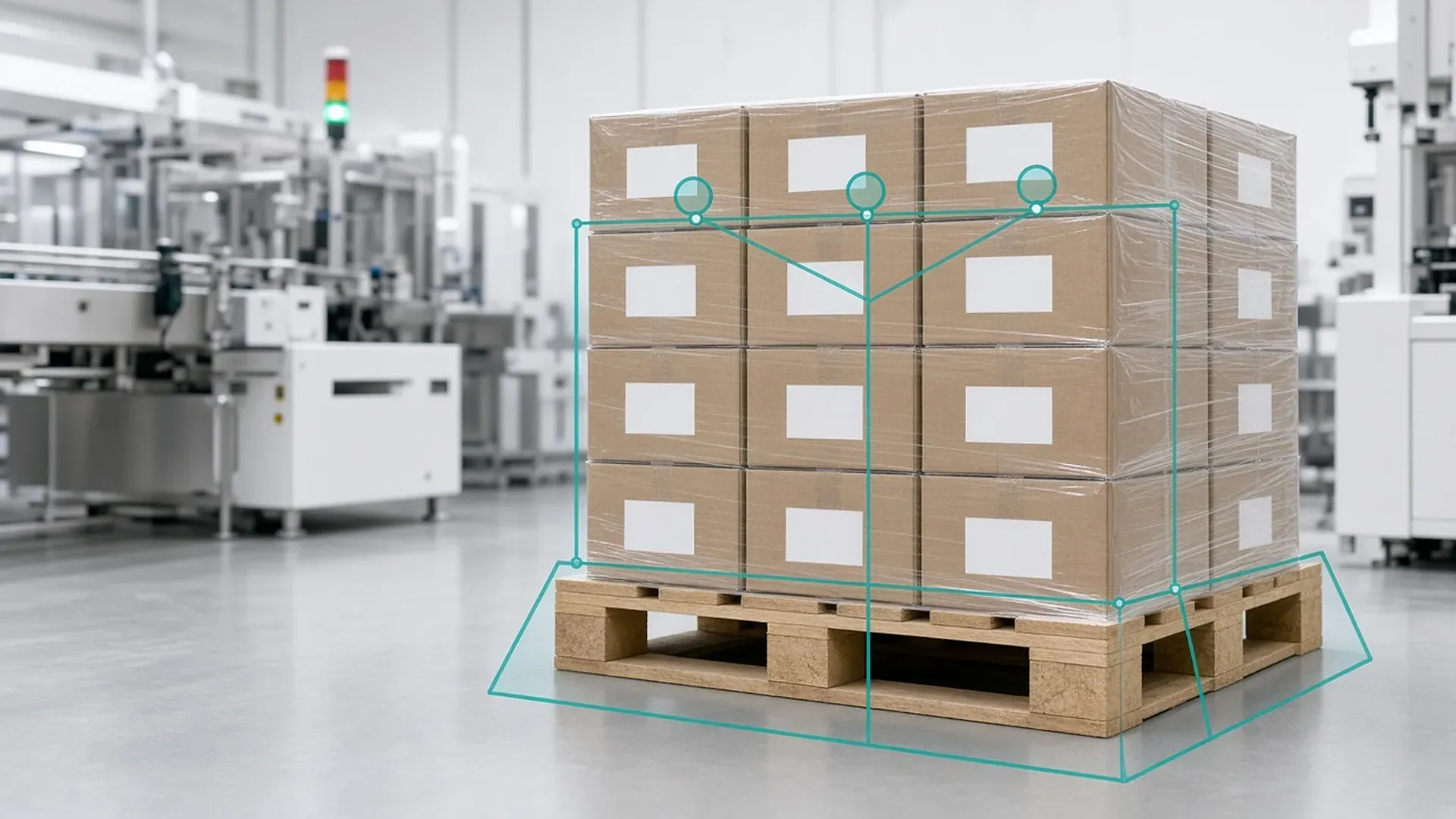
The question “what is an SSCC” becomes concrete when someone stands in front of a pallet. The person at the door does not want to scan every carton. The reader sees the single code on the pallet label and has to recognise the cartons inside that unit. This article explains what that code is and at which moment it is born on the packaging line. We covered how the station is set up in our aggregation article, and how the project is scoped in our integration planning article. Here the subject is the identity itself.
The names come from the GS1 SSCC page and from the İlaç Takip Sistemi page on its.gov.tr. We do not print a sample company prefix. That number is a record GS1 assigns to a member.
What an SSCC is, and why it is not the carton serial
The SSCC is the GS1 key for a logistics unit. A logistics unit is a container built to be transported or stored. A case, a pallet and a similar container fit that definition. The key identifies the container. It does not write the medicine name, the strength or the carton count into the digits. Those facts sit in the record the key opens.
On the warehouse floor the job is practical. The reader sees 18 digits and asks the record. The record returns the child list, the moment the unit was built and the shipment it belongs to. An order number or a carton count is not written inside the digits. The count is the length of the child list. If the list and the label are stored apart, a scan is only a number.
Each container receives its own number. Two cases built from the same batch and the same count still have two SSCCs. One cannot be scanned in place of the other. The party that builds the container allocates the number. The GS1 Company Prefix does not say which plant the goods left. It identifies the party that makes the number unique worldwide. On most lines that party is the manufacturer building the case or the pallet.
The number belongs to that container for its life. GS1 requires that an SSCC not be given to another logistics unit for at least twelve months, and recommends that it never be reused. The old record may still sit in the receiver’s system. Shipping a new case under an old number ties two stories to one label.
GTIN, serial and SSCC are three different keys
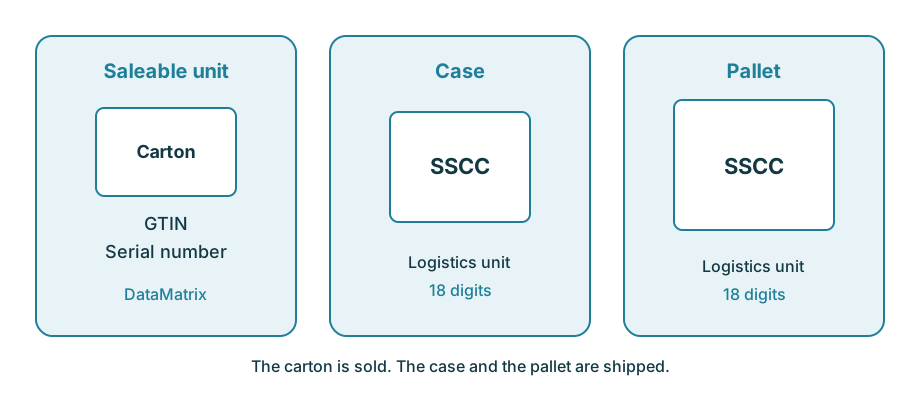
The GTIN identifies the trade item. Every carton of the same medicine carries the same GTIN. The serial number separates one carton inside that GTIN. Together with batch and expiry, those four values sit in the carton’s DataMatrix. We describe where that code sits on the line in our serialization article.
The SSCC is not a short form of those four values. The carton is sold. The case and the pallet are shipped. The saleable unit’s identity is the DataMatrix. The logistics unit’s identity is the SSCC printed on the label at the moment the unit is built. Treating the carton serial as the case number breaks the single scan at shipping. The reader expects a carton and sees a container, or the reverse.
The three keys can stand side by side in the same record. The record says: this GTIN and serial sit under this case SSCC, and that case sits under this pallet SSCC. None of them is written into another’s digits.
How the eighteen digits are arranged
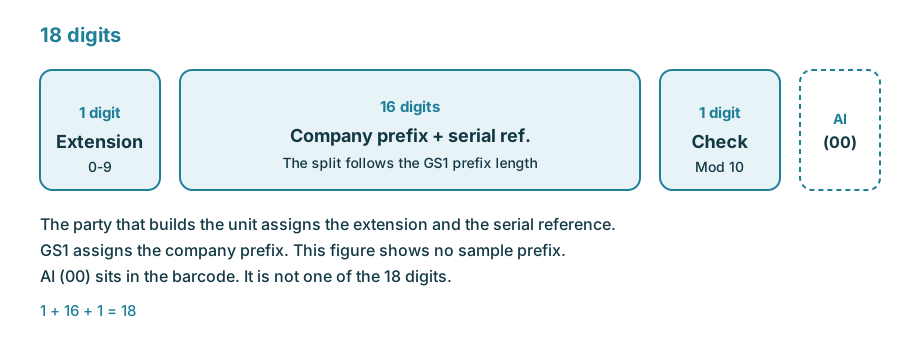
An SSCC has 18 digits, in three parts. The first is a single digit called the extension. The party that builds the container chooses a digit from 0 to 9. That digit is not a product class. It increases the capacity of the serial reference.
The middle 16 digits are the GS1 Company Prefix plus the serial reference. A GS1 member organisation assigns the prefix. Its length depends on the membership issued to the company. A shorter prefix leaves a longer serial reference, and a longer prefix leaves a shorter one. The total is always 16 digits. The party that builds the container also assigns the serial reference. The simplest way is to increase the number in order and keep a record of what was issued. This article contains no numeric sample prefix.
The extension digit is not a case count. The serial reference is not the carton’s serial number either. The carton serial sits inside the DataMatrix and belongs to the saleable unit. The SSCC serial reference sequences the logistics unit. Drawing both numbers from the same pool merges the carton and the case into one identity.
The last digit is the check digit. It is calculated from the first 17 digits with the modulo 10 rule. An operator does not choose it. If the barcode is misread, or a digit changes place, the check fails and the label is not accepted.
The barcode on the label is usually a GS1-128. Application identifier (00) says that the data which follows is an SSCC. (00) is not part of the eighteen digits. Once the barcode is decoded, the identity that remains in the record is 18 digits.
When the number is allocated on the line
An SSCC is not born when the work order opens. It is not preprinted on the side of an empty case either. GS1 expects the label to be produced when the logistics unit is built. Giving an official identity to a container whose contents are still unknown puts a faulty unit into the chain.
The sequence on the line is short. The child units are read. The count and the batch agree. The list closes. Only then is the number allocated, the label printed, and the barcode read and verified. The container does not go to shipping until verification says it is good. A rejected carton does not enter this list. A short or overfilled case does not receive a label.
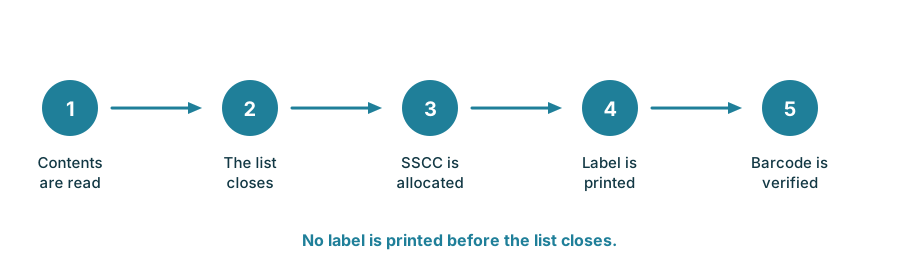
The allocated number stays in the same record as the moment it was born and the child list. Without that record the label is a piece of paper. If two cases receive the same number, one scan in the warehouse opens the wrong tree. The pool must not give the same next number to two lines at once. A label that was printed and not verified counts as used, and does not go onto a second container.
What the line hands to the enterprise system at this moment is not a picture of a label. The work order, the product, the closed child list, the 18 digits allocated and the moment verification said good have to arrive in the same record. A number that stays on the line screen and never reaches the enterprise record does not yet exist for shipping.
Who allocates the number is written in the scope. If the manufacturer builds the case, the manufacturer’s prefix is used. If another party builds the pallet in the warehouse, the number can come from that party’s prefix. The same container is not numbered by both parties. Two labels mean two identities in the warehouse.
Where the SSCC sits in the case and pallet tree
The case’s parent identity is an SSCC. Under it sit the GTIN and serial numbers of the cartons that were read. If a bundle is used as an intermediate level, that bundle can carry a logistics identity of its own. The pallet’s parent identity is a different SSCC. Under it sit the case numbers. Scanning the pallet opens the case list and, through each case, the carton list.
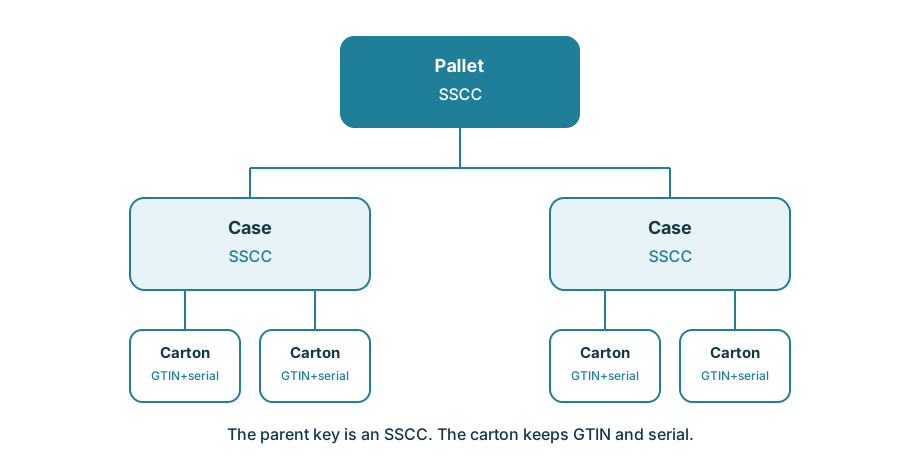
How the station builds this tree is in our aggregation article. The identity rule here is this. The parent SSCC is born after the child list closes. If the list changes later, the relationship is undone. The new list closes under a new number. The old label is not scanned again. Sticking the old number onto the new list shows the receiver the wrong contents.
A scan at shipping does not replace the notification
At the shipping door the SSCC says which order the container is leaving on. One scan brings the serial list inside it. That scan does not mean the İTS sale notification has been made. The sale notification is the cartons leaving for the next stakeholder. its.gov.tr defines that notification apart from the container’s label.
The hierarchy also travels to the receiver as a file. The Package Transfer System carries case and pallet contents through the SSCC. Sending the file does not notify the cartons inside it. The file matches the number the receiver will scan with the child list. The notification writes the movement of the cartons. The key for both steps is the SSCC born on the line. Without the number, neither the file nor the notification list can be tied to the case. We cover the split between those two steps in our notification article and in the planning article.
Two failures show up often at the door. The barcode is read, but the check digit does not agree. The label is not reprinted at once. The digits just read are compared with the number on record first. The second failure is a number that reads while the child list comes back empty. Shipping waits. A label printed before the list closed, or a tree that never reached the record, shows up here. The short container is completed before the truck is loaded.
Another account that gathers the same headings can be read on the Technarts İTS content page. That page is a reading list. softhan is not a partner of that site.
Where we keep this record
We are the integration layer. We keep, in the enterprise record, the moment an SSCC was allocated, the child list it closed with, and the fact that the same tree opens when shipping scans it. We are not the organisation that issues GS1 numbers. We do not replace İTS. The boundary of the service is on the pharma serialization and İTS page.
Frequently Asked Questions
Does an SSCC replace the carton serial number?
No. The serial number separates the saleable unit and sits inside the DataMatrix. The SSCC separates the logistics unit and sits on the case or pallet label.
Can two cases of the same product share one SSCC?
No. Even when the medicine inside is the same, each container has its own number. One number would tie two containers to one story in the warehouse.
Is the label printed before the child list closes?
It should not be. The number is allocated after the child units have been read and the list has closed. A label printed early gives an official identity to a faulty container.
Does scanning an SSCC mean the İTS sale notification was made?
No. The scan recognises the container and the serials inside it. The sale notification goes separately. The hierarchy file does not replace the notification either.
Facing a similar challenge? Tell us about your project and we will get back to you within one business day.
System and standard names belong to their respective owners. softhan is not an authorized representative or partner of GS1 or of the authority that operates İlaç Takip Sistemi.